
Titanium Plate Flat Iron vs Ceramic: Which Suits Your Hair Type
Titanium irons with adjustable heat suit thick or coarse hair. Ceramic irons are often chosen for fine, fragile or dyed hair at lower settings. Here is how to decide.
The Calvedon Team
October 17, 2026 · 8 min read
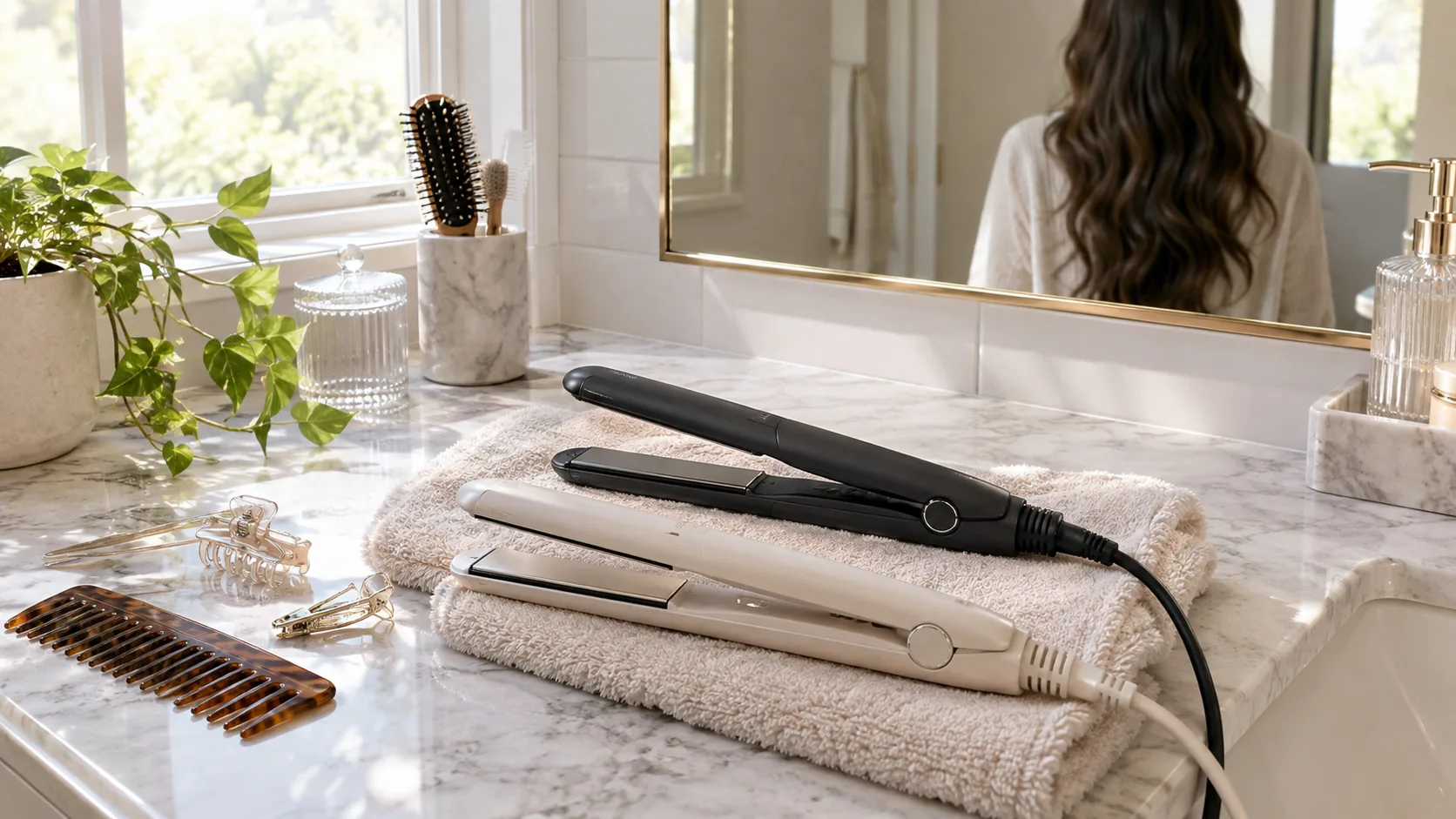
In a titanium plate flat iron vs ceramic choice, titanium irons with adjustable controls suit thick, coarse or hard-to-straighten hair. Ceramic irons are often chosen for fine, fragile or dyed hair, used at lower settings. Your hair type and how precisely you can set the heat matter more than the plate name.
This guide compares the two plate types, explains heat distribution and hot spots, matches each to hair textures, and ends with a short decision flow.
Titanium plate flat iron vs ceramic: what actually differs
The difference starts with how the plate is built. Titanium plates may be solid titanium or a titanium coating over another metal, so read the product description. Ceramic plates are typically a metal base with a ceramic coating, and some are labeled tourmaline ceramic, meaning a crushed mineral is added to that coating.
Both can leave hair smooth when used correctly. What changes is how the surface glides, how the plates wear, and how much room the controls give you to adjust for your hair. For a hair flat iron ceramic vs titanium decision, start with those three points.
Titanium flat irons
Titanium plates have a smooth, hard surface. Temperature control comes from the iron's heater and display, not from the plate material, so look for a model with a clear readout and an adjustable temperature range.
That pairing suits thick, coarse or curly textures that need a specific, steady setting to hold a straight shape. The trade-off is that a titanium straightener set too high stresses hair just as quickly as any other plate.
Ceramic flat irons
Ceramic is a coating, and the glide comes from that surface layer. Ceramic flat irons are often chosen for fine, thin or dyed hair, typically with the setting kept low.
Coatings can wear with use, so check the surface over time. Product residue on the plates can also change how they glide and may leave uneven patches on the surface.
Pros and cons at a glance
- Titanium, pros: smooth hard surface, suits thick or coarse hair, pairs well with digital controls.
- Titanium, cons: easy to overheat fine hair if the minimum setting is high.
- Ceramic, pros: commonly paired with lower settings for fine or dyed hair.
- Ceramic, cons: the coating can wear or collect residue.
Comparison table: heat, evenness and temperature range
Heat-up time, heat evenness and temperature range depend on the heater design and plate size of each model, not only the material. Use this table as a starting point, then check the spec sheet and manual of the iron you are considering.
| Factor | Titanium plates | Ceramic plates |
|---|---|---|
| Plate construction | Solid titanium or titanium-coated; check the description | Metal base with ceramic or tourmaline-ceramic coating |
| Heat-up | Varies by model; check the manual | Varies by model; check the manual |
| Heat evenness | Check that the plates sit flush, fully cover the heater and have a smooth surface | Check that the plates sit flush, fully cover the heater and show no worn patches |
| Temperature range | Varies by model; confirm the minimum and maximum | Varies by model; confirm the minimum and maximum |
| Surface | Smooth; check whether it is solid or coated | Coating that can wear or collect residue |
| Typical use | Thick, coarse, curly or resistant hair | Fine, thin, dyed or fragile hair |
| Main watch-out | Setting the temperature too high for your hair | Using a worn coating or stacking passes |
The most useful number on any iron is the lowest temperature setting. A low minimum lets you start gently and work up only if the hair needs it.
Heat distribution and hot spots
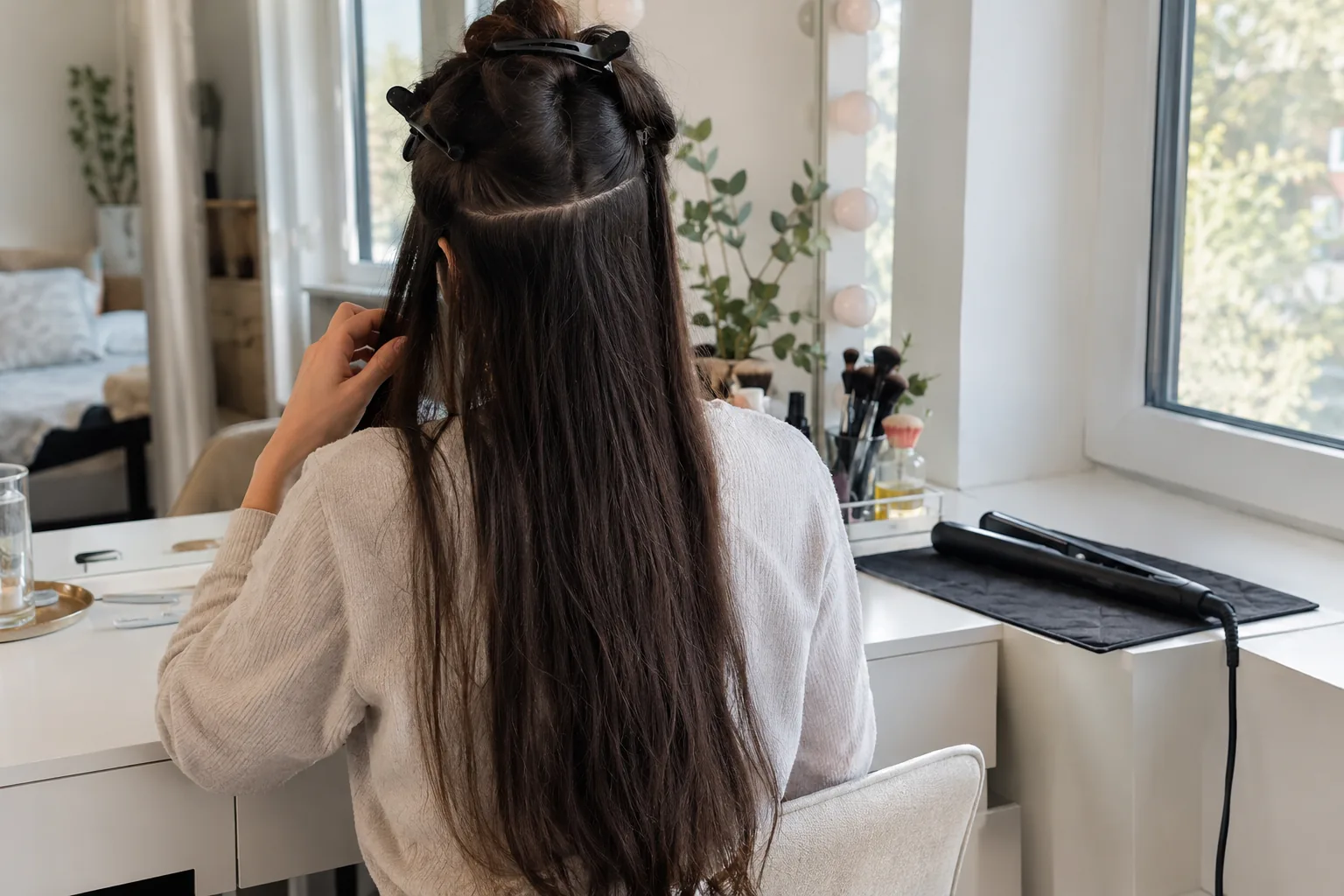
Heat distribution describes how evenly distributed the warmth is across the plate surface. If part of a plate runs hotter than the rest, that area is a hot spot, and hair passing over it gets more heat than you set.
You cannot judge this from the plate name alone. Look at how the plates close: they should meet flush along their full length, with no gap or wobble. Check that the plates are smooth and that the surface has no chips, flaking or rough patches.
A steady glide also matters. Stopping in one place concentrates heat, whichever material you pick, so keep the iron moving at an even pace.
Which plates suit which hair type
Use these as starting points. Every head of hair is different, so begin at the low end of the range and adjust in small steps.
| Hair type | Leans toward | Starting approach |
|---|---|---|
| Fine or thin | Ceramic, or titanium on a low setting | Lowest setting that works, one pass per section |
| Thick or coarse | Titanium with adjustable heat | Small sections, raise heat gradually |
| Curly or coily | Titanium with adjustable heat | Fully dry hair, moderate setting, slow even glide |
| Dyed or damaged | Either, with a low and precise setting | Low setting, heat protectant, skip repeat passes |
| Wavy, medium texture | Either | Pick on temperature control, not material |
Curly and coily hair
For tight curl patterns that resist straightening, a titanium iron with adjustable heat is one option, and a ceramic iron with a clear low-to-high range is another. The deciding factor is control: a digital display, a lock so the setting does not shift, and a plate wide enough to take workable sections.
Textured hair can be more fragile when dry, so use a heat protectant, work on fully dry hair, and stay at the lowest setting that gives the result you want. That also helps limit frizz and split ends from repeated passes.
Curling with a flat iron
If you mean making curls or waves with a flat iron, the plate type matters less than the plate edges and the glide. Look for rounded edges and a smooth surface that slides without catching. Tourmaline plates and titanium can both be used this way, and a separate curling iron is another route if you want tighter shapes.
Pick a setting the same way you would for straightening: start low, use a heat protectant, and keep sections small. Rotate the iron smoothly as you pull down, without pausing in one spot.
Fine and fragile hair
Fine hair reaches styling temperature with little heat, so a high setting is rarely needed. Ceramic is a reasonable option, and a titanium iron set low works too. When choosing the least damaging flat iron, the answer comes down to the temperature, the number of passes and the condition of your hair, not the plate material alone.
Thick and coarse hair
Thick hair needs smaller, neat sections more than it needs extra heat. A wider plate helps with volume, but only if the sections are even. Raise the setting one step at a time instead of jumping to the maximum.
Decision flow: choose in five steps
To settle a titanium plate flat iron vs ceramic decision, work through these steps in order.
- Check your hair thickness. Fine or thin leads to a low-temperature approach and either plate type. Thick or coarse leads to titanium with adjustable heat.
- Check your texture. Curly or coily hair calls for an iron with an adjustable range, which points to models with a digital display.
- Check its condition. Dyed, dry or fragile hair needs a low minimum setting. Confirm the iron goes low before you buy.
- Check the controls. Prefer a digital readout, a temperature lock and auto shutoff over a vague high/low switch.
- Check the fit. Plate width, handle shape and cord length decide whether you will use it comfortably.
If you land between two answers, choose the iron with the wider and more precise temperature range. Control is what you can adjust; the plate material is not.
A titanium option with a digital range
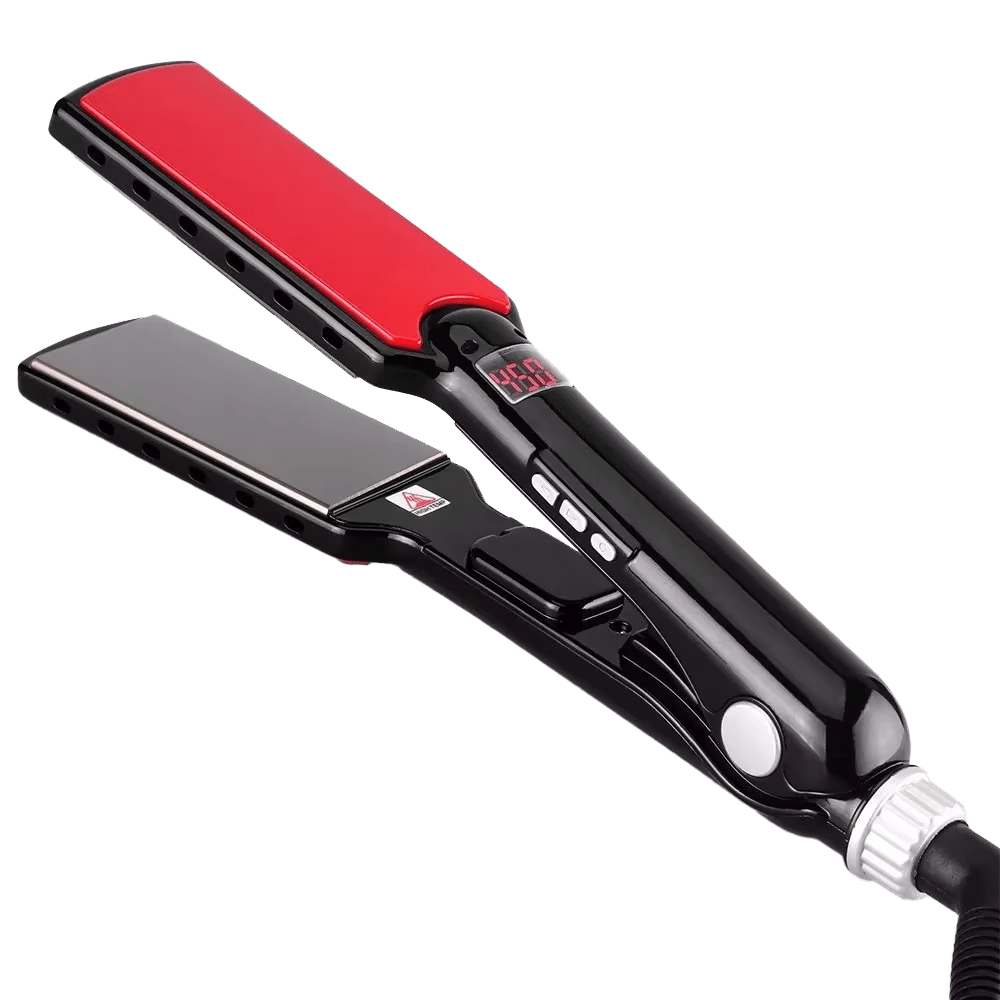
If your decision flow points to titanium, the LuxeSilk Pro is the iron we stock for that case. It has solid titanium plates rather than a ceramic coating, and a digital display that lets you set the temperature from 120°C to 240°C (about 248°F to 464°F). That range lets you choose a setting for fine, damaged or coarse hair.
The plates are wide for larger sections, and the handle is ergonomic with a long cord. It also has auto shutoff after a period of inactivity, a temperature lock and universal voltage, so you can use it while traveling with a plug adapter. A heat-resistant travel pouch comes in the box.
 In this guideLuxeSilk Pro$119.00View
How to use either plate type with care
- Wash and fully dry your hair. Styling damp hair with a hot plate is a common cause of heat damage.
- Apply a heat protectant and comb through.
- Select a temperature and wait for the plates to reach it, then divide the hair into sections.
- Glide the plates from root to tip in one steady motion without stopping in one spot.
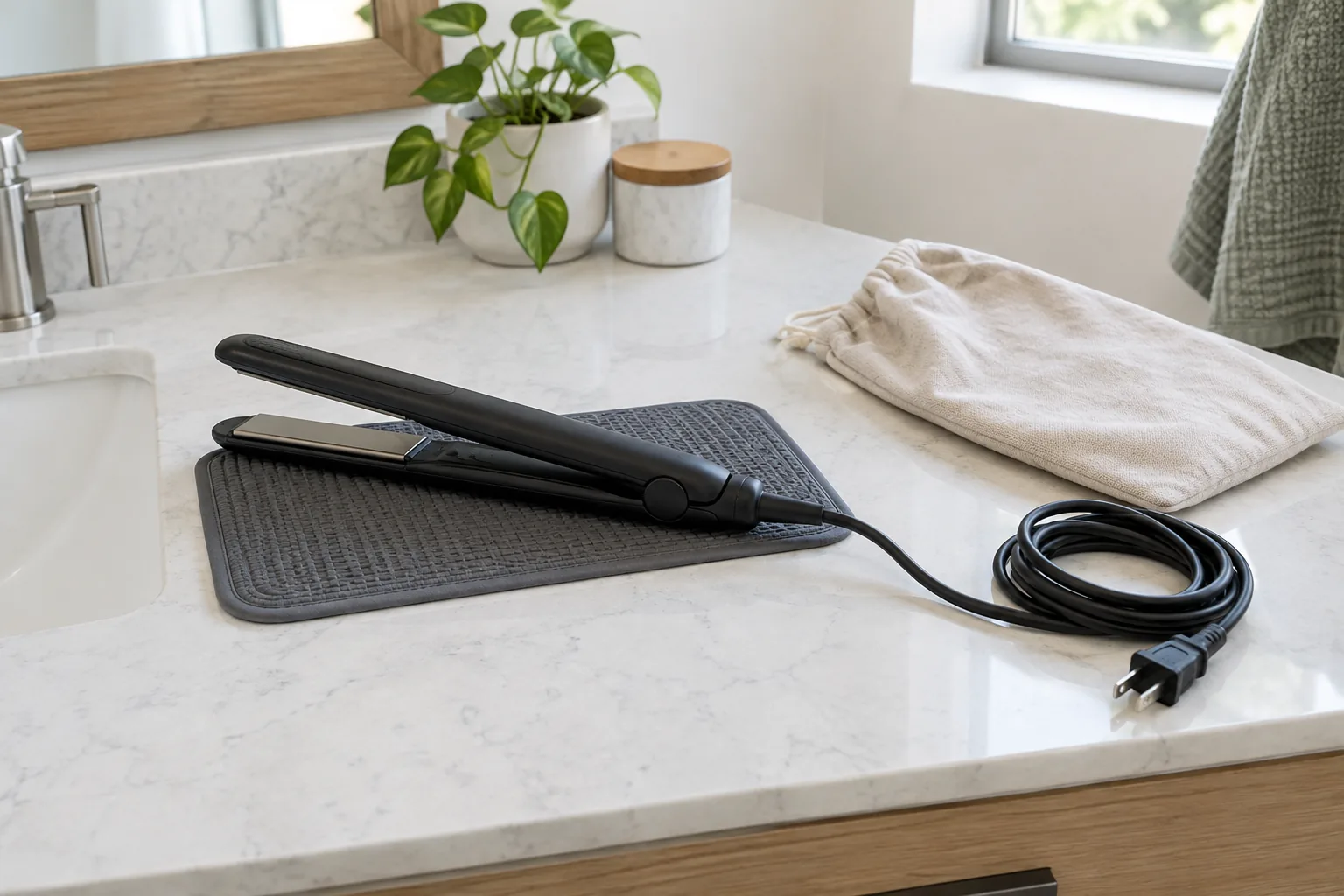
- Turn the iron off, unplug it and let it cool on a heat-resistant surface before you store it.
On your first session with a new iron, read the user manual, start at the bottom of its range and try a small hidden section first.
Field note
Write down the setting that works for each section of your hair, such as the nape versus the crown. A temperature lock then keeps that number steady while you style.
Common mistakes when comparing plates
Most errors in a titanium plate flat iron vs ceramic comparison come from focusing on the label instead of the settings.
- Choosing by material alone. Temperature matters as much as material: a high setting stresses hair on any plate type.
- Skipping the minimum temperature. If an iron cannot go low, it limits you on fine or fragile hair.
- Repeated passes. Going over the same section many times adds heat exposure. Use smaller sections instead.
- Ignoring plate condition. A visibly worn coating or rough patch changes how the plates glide.
- Styling dirty or product-heavy hair. Residue can build up on the plates and change how they glide.
Care and safety checklist
- Unplug and let the iron cool before cleaning or storing.
- Wipe the plates with a soft, slightly damp cloth once cool, and follow the user manual.
- Keep a hot iron and its cord out of reach of children, and let it cool on a heat-resistant surface.
- Keep the cord loosely coiled, not tightly wrapped.
- Store in a pouch or on a heat-resistant surface away from water.
- If the cord or plates look damaged, stop using the iron, unplug it, and contact the manufacturer or an electrician.
Browse more heat and light styling tools in our Dryers, Irons & Light-Based Hair Devices collection. If you also style facial hair, see how to use a beard straightener without frying your beard for the same heat-control habits.
Frequently asked questions
Keep reading
 Shavers & Precision TrimmersShaving Head With Electric Shaver: A Step-by-Step Routine8 min read
 Dryers, Irons & Light-Based Hair DevicesHow to Use a Beard Straightener Without Frying Your Beard7 min read
 Shavers & Precision TrimmersChoosing a Good Electric Shaver for Women: Foil, Rotary or Trimmer7 min read